The bill tells you about your usage weeks late, sometimes estimates it, and by the time an increase shows up on paper it happened long ago. Meters, on the other hand, tell the truth at any moment: you just need to know where to look and note the numbers with a little regularity. With a few readings a month you learn how much your home really uses, compare months and years, and catch a fault or a leak in time.
Electricity
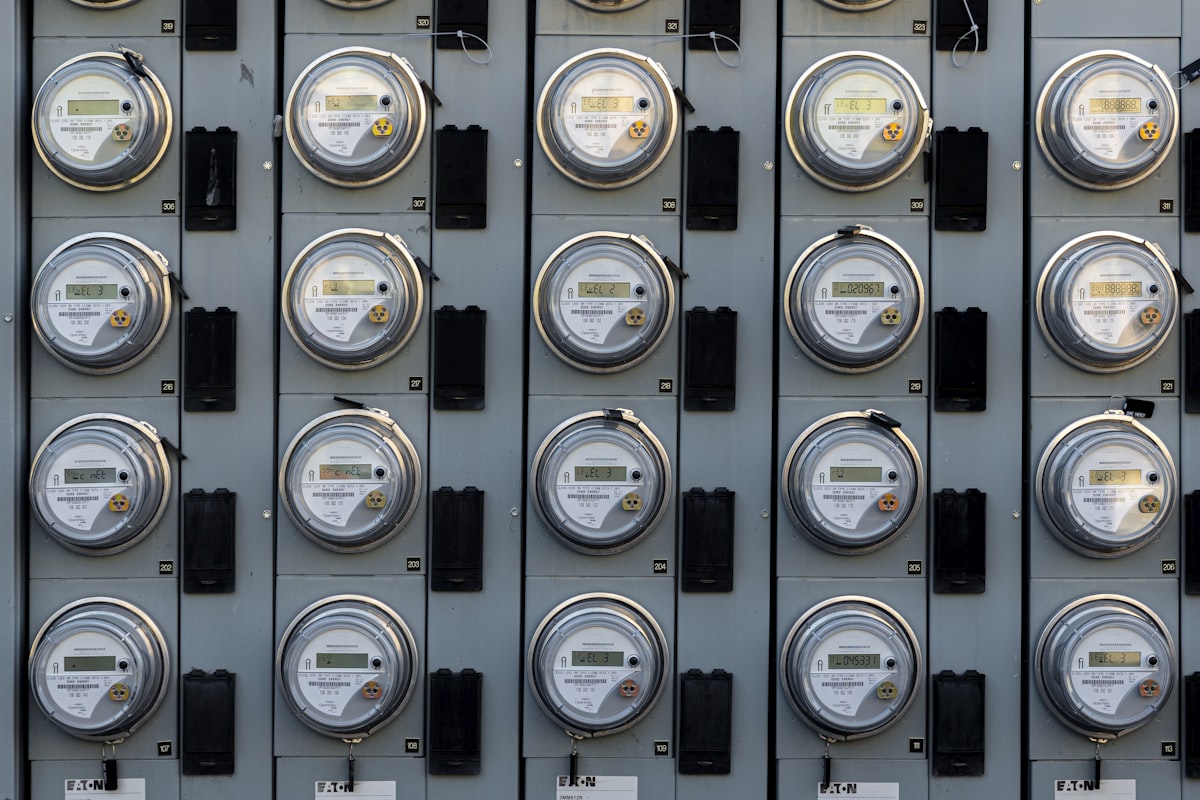
The electricity meter at home is almost always electronic: a display and a button. Pressing the button cycles through the screens, including the readings of energy used, in kWh, split into time bands. The labels vary from model to model, and your local distributor’s website explains which screens to look at.
In Italy the bands are set by ARERA, the energy regulator, and are the same for every supplier:
- F1, peak hours. Monday to Friday, 8 am to 7 pm, public holidays excluded.
- F2, mid-peak hours. Monday to Friday 7 to 8 am and 7 to 11 pm; Saturday 7 am to 11 pm.
- F3, off-peak hours. Monday to Saturday 11 pm to 7 am, Sundays and public holidays all day.
Noting the three bands separately tells you when you use energy, not just how much. If you’re on a time-of-use plan, moving the washing machine and dishwasher to the evening or the weekend shows up in the numbers straight away. With electronic meters the distributor reads usage remotely, so a self-reading for electricity usually isn’t needed.
Gas
The gas meter shows a number in cubic metres. The black digits are whole cubic metres, the red ones or those after a comma are decimals: for a self-reading you report only the whole digits. In areas where electronic meters have been installed, the number appears on a display.
Here the self-reading matters: submitted on the days shown on your bill, it lets the supplier charge for actual usage instead of an estimate, and avoids balancing charges later. You send it through the supplier’s customer area or app.
If you smell gas, don’t touch switches or use flames: close the valve near the meter, open the windows, get out and call the distributor’s emergency number, which is printed on your bill.
Water
The water meter records cubic metres, often with small dials or a little star that spins when water flows. It’s also the simplest tool for finding a leak.
- Turn off every tap and make sure the washing machine, dishwasher and toilet cisterns aren’t filling.
- Watch the meter for a few minutes, or note the number before going out and compare it when you’re back.
- If it moves, there’s a leak downstream of the meter: a dripping tap, a leaking cistern, a broken pipe inside the wall.
A hidden leak can be expensive, because water lost inside your home’s plumbing is usually paid for by whoever holds the contract. Noticing it after a week rather than at the next bill makes all the difference.
How often to read, and how to record it
- Once a month, always on the same day. That’s enough to see the trend and compare years. Before and after a trip or a change in habits, an extra reading helps.
- Together with the date. Usage over a period is the difference between two readings, and you need to know how many days have passed.
- In one place. Scraps of paper and scattered photos can’t be compared; a spreadsheet or an app can.
DomoMeter, free for iPhone, iPad and Android, is built for this: you record electricity readings (by band too), gas and water, and the app works out your usage, spreads it across months even if you read on irregular dates and compares it with previous months and years, with a yearly limit for each utility. No account is needed and the data stay on the device; on iPhone and iPad you can sync them with iCloud if you want. The guide to readings and time bands explains how to record the bands.
Tip: take a photo of the meter every time you read it. If a bill doesn’t add up, a photo with a clear date and number is the simplest proof to send to your supplier.
What to keep in mind
Reading the meters takes two minutes a month and changes how you look at the bill: from a surprise that arrives in the post to a number you already know. Electronic meters will make this information increasingly available online too, but the habit of looking at the numbers, and comparing them with last year’s, remains the simplest way to notice that something has changed.